
Not long ago, digital marketing was mostly about visibility—getting your brand in front of as many people as possible and hoping some of them would eventually convert. That approach doesn’t work anymore. Today, businesses expect every marketing dollar to prove its value. If a campaign can’t show measurable results, it quickly loses priority. That’s exactly where a well-planned performance marketing guide becomes essential.
Performance marketing flips the traditional mindset. Instead of paying for exposure alone, you invest in campaigns that are tied to real outcomes—clicks, leads, sign-ups, and sales. Every interaction may be monitored, quantified, and improved. This change may initially seem intimidating to marketers who are unfamiliar with the field, but it also allows for more informed, data-driven decision-making.
This performance marketing guide breaks down the entire process in a practical way—from understanding the core concepts to building campaigns that actually generate revenue.
Foundations of Performance Marketing
Before diving into tactics and campaign strategies, it is important to understand what performance marketing truly represents and why it has become a dominant approach in digital advertising. This section of the performance marketing guide focuses on the underlying principles that define this model.
What Performance Marketing Actually Means
In performance marketing, which is a results-oriented strategy, advertisers only pay when certain events take place. These actions may include clicks, leads, app installs, or direct purchases. This model aligns marketing budgets with measurable outcomes, which makes it attractive to businesses seeking efficiency.
Traditional marketing often emphasizes reach and brand awareness. While these goals remain important, modern marketers increasingly prefer channels where results can be tracked precisely. A comprehensive performance marketing guide emphasizes how every marketing decision should ultimately connect to measurable growth.
Several marketing channels operate under the performance model, including paid search advertising, social media advertising, affiliate marketing, and native advertising networks. Each of these platforms allows marketers to track metrics such as cost per acquisition (CPA), return on ad spend (ROAS), and conversion rates.
Why Businesses Are Prioritizing Performance Marketing
Modern businesses are operating in an environment where competition is intense and customer attention spans are limited. Companies cannot afford to invest heavily in campaigns that do not deliver measurable outcomes.
Studies consistently show that data-driven organizations are significantly more likely to acquire customers and retain them over time. In fact, research from McKinsey suggests that organizations using advanced analytics in marketing are more likely to outperform competitors in profitability.
A strong performance marketing guide helps marketers understand how data enables smarter decision-making. Instead of relying on intuition, marketers can evaluate campaign performance in real time and optimize strategies accordingly.
The Core Players in the Performance Marketing Ecosystem
Performance marketing is rarely a one-sided process. Multiple stakeholders participate in the ecosystem, each playing a specific role in delivering results.
Advertisers are businesses that want to promote products or services. They define campaign objectives and allocate budgets for advertising initiatives. Publishers or affiliates promote these offers across websites, blogs, or digital platforms in exchange for commission-based rewards.
Marketing platforms such as search engines, social networks, and ad exchanges act as intermediaries. These platforms provide targeting capabilities, analytics dashboards, and automated optimization tools that support campaign management.
Understanding this ecosystem is a fundamental step in any performance marketing guide, as it clarifies how different participants contribute to measurable outcomes.

Building a High-Performing Performance Marketing Strategy
Once the foundational principles are clear, the next step is creating campaigns that consistently produce measurable outcomes. A strategic performance marketing guide must focus on campaign structure, audience targeting, and optimization processes that drive results.
1. Designing Campaigns Around Measurable Objectives
The success of any campaign begins with clear goals. Performance marketing does not operate on vague objectives such as “increase visibility.” Instead, campaigns are designed to achieve quantifiable outcomes.
A well-planned campaign might aim to generate a specific number of leads, increase online sales by a defined percentage, or reduce acquisition costs. When objectives are measurable, marketers can analyze performance more accurately.
The most effective campaigns focus on key performance indicators such as conversion rate, cost per acquisition, and return on ad spend. By aligning campaigns with these metrics, businesses ensure that marketing budgets contribute directly to revenue growth.
This is why a practical performance marketing guide always emphasizes goal setting as the starting point of every marketing initiative.
2. Selecting the Right Marketing Channels
Performance marketing thrives across multiple digital channels. However, choosing the right channel depends on business goals, audience behavior, and campaign objectives.
Search advertising is often one of the most effective channels because it targets users with high purchase intent. When people search for a product or service, they are already demonstrating interest. Paid search campaigns capture this intent and convert it into measurable outcomes.
Social media advertising provides sophisticated audience targeting. Platforms like Facebook, Instagram, and LinkedIn allow advertisers to target users based on demographics, interests, and behavioral patterns. This level of precision increases the likelihood of reaching relevant prospects.
Affiliate marketing is another powerful component discussed in many advanced sections of a performance marketing guide. In this model, publishers promote products and earn commissions for successful conversions, creating a performance-based partnership between brands and promoters.
3. The Significance of Conversion Funnels
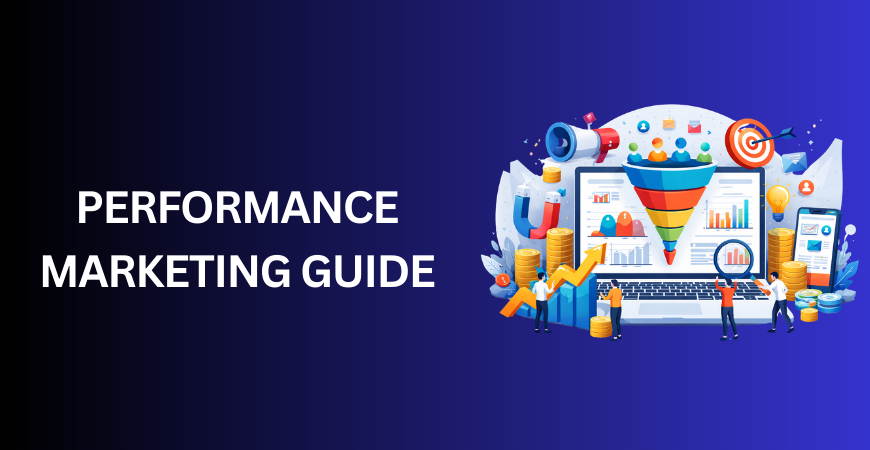
A successful campaign doesn’t end with a single click. Instead, performance marketing relies on conversion funnels that guide potential customers through a journey from awareness to purchase.
At the top of the funnel, campaigns focus on attracting attention and generating interest. Display ads, social campaigns, and video marketing often play a role in this stage.
The middle of the funnel emphasizes engagement and evaluation. Retargeting campaigns remind users about products they previously viewed, encouraging them to reconsider their purchasing decisions.
At the bottom of the funnel, marketers focus on conversion optimization. Landing pages, product offers, and calls to action are refined to maximize the likelihood of completing a purchase or generating a lead.
A detailed performance marketing guide explains how each stage of the funnel contributes to overall campaign performance.
4. Using Data to Continuously Optimize
One of the most powerful aspects of performance marketing is the ability to optimize campaigns based on real-time data. Marketers constantly analyze metrics to identify opportunities for improvement.
Small adjustments in ad creatives, targeting parameters, or bidding strategies can significantly impact results. A/B testing allows marketers to compare different versions of ads or landing pages to determine which variation performs better.
These little improvements add up to big gains in performance over time. This continuous optimization process is central to any effective performance marketing guide because it ensures that campaigns remain efficient and profitable.
5. Combining Complementary Marketing Methods
Performance marketing rarely operates in isolation. Businesses often combine it with other digital marketing strategies to maximize results.
For example, content marketing can generate organic traffic that complements paid campaigns. Similarly, businesses often link paid campaigns with email strategies because nurturing leads through email can increase conversion rates. Many companies explore the Benefits of Email Marketing to strengthen relationships with prospects who are not yet ready to purchase.
Reputation also plays a role in conversion rates. If potential customers encounter negative reviews, they may hesitate before completing a purchase. Implementing orm in digital marketing helps businesses manage online reputation and maintain trust with audiences.
Another powerful complement is search optimization. Businesses investing in local seo strategies can capture nearby customers actively searching for products or services. When combined with performance campaigns, local search visibility can significantly increase lead generation and customer acquisition.
Advanced Performance Marketing Guide: Optimization and Scaling Techniques
Once campaigns begin delivering results, marketers must focus on scaling strategies while maintaining efficiency. The final section of this performance marketing guide explores advanced techniques that help marketers transition from beginner-level campaigns to professional-grade marketing systems.
1. Understanding Attribution Models
One of the biggest challenges in digital marketing is determining which channels deserve credit for conversions. Before making a purchasing choice, customers frequently engage with several touchpoints.
Attribution models help marketers evaluate the contribution of each channel in the customer journey. For example, a user may first encounter a brand through a display ad, later search for the product on Google, and finally convert after clicking a retargeting advertisement.
Without proper attribution analysis, marketers might misinterpret campaign performance and allocate budgets inefficiently. Advanced sections of a performance marketing guide often emphasize attribution because accurate insights lead to smarter budget distribution.
2. Optimizing Landing Pages for Conversions
Getting people to visit your website is just the first step. The real challenge is turning those visitors into actual customers—and that’s where a well-designed landing page makes all the difference.
Effective landing pages focus on clarity, relevance, and persuasive messaging. They communicate the value proposition quickly and eliminate distractions that might interrupt the conversion process.
Small improvements in page design—such as clearer calls to action, faster loading speeds, and improved mobile usability—can significantly increase conversion rates. For this reason, landing page optimization remains a recurring theme in every practical performance marketing guide.
3. Employing AI and automation in campaign management
Modern advertising platforms rely heavily on artificial intelligence and machine learning algorithms. These technologies analyze vast amounts of data to identify patterns and optimize campaigns automatically.
Automated bidding strategies adjust bids in real time to maximize conversions within a specified budget. Similarly, machine learning models analyze user behavior to predict which audiences are most likely to convert.
Marketers who understand how to leverage these technologies can dramatically improve campaign efficiency. A forward-thinking performance marketing guide highlights how automation tools reduce manual effort while improving performance outcomes.
4. Scaling Campaigns Without Losing Efficiency
Scaling marketing campaigns requires careful planning. Increasing budgets too quickly can lead to declining returns if campaigns are not properly optimized.
Experienced marketers scale campaigns gradually by expanding audience segments, increasing ad placements, or testing additional marketing channels. They monitor performance metrics closely to ensure that increased spending continues to produce profitable results.
Scaling also involves replicating successful campaigns across new markets or geographic regions. Businesses that master this process can transform performance marketing into a predictable growth engine.

Conclusion
Performance marketing has fundamentally changed the way businesses approach digital advertising. Instead of relying on guesswork or broad exposure, marketers now have the ability to track every interaction and evaluate campaign effectiveness with precision.
A well-structured performance marketing guide reveals how data-driven strategies can turn advertising investments into measurable growth. From understanding the fundamentals of performance-based campaigns to optimizing funnels and scaling successful strategies, the principles outlined in this article demonstrate how marketers can evolve from beginners into confident professionals.
Ultimately, performance marketing is not just about running advertisements—it is about building systems that continuously learn, adapt, and improve. Businesses that embrace this approach gain a significant advantage in today’s competitive digital landscape. By focusing on measurable results and continuous optimization, marketers can ensure that every campaign contributes meaningfully to long-term growth.
FAQs
1. What is performance marketing in simple terms?
Performance marketing is a digital advertising model where businesses pay only when specific actions—such as clicks, leads, or sales—occur. It focuses on measurable results, helping marketers track performance and optimize campaigns for better ROI. A strong performance marketing guide helps marketers understand how to track these results and optimize campaigns to maximize return on investment.
2. What metrics matter most in performance marketing?
Successful performance marketing campaigns rely on measurable metrics like CPA, ROAS, and conversion rate. These indicators help marketers track costs, revenue, and user actions to evaluate and optimize campaign performance.
3. How is performance marketing different from traditional marketing?
Traditional marketing prioritizes brand exposure and reach via channels like print, television, and outdoor advertising, but it’s hard to quantify its precise effect on sales. As highlighted in any successful performance marketing guide, data is the foundation of performance marketing, which tracks every click, conversion, and cost in order to optimize campaigns in real time.


