Introduction
Think about the last time you contacted a business with a simple question. You probably wanted an answer immediately, not after waiting hours for a support agent. AI in customer service is helping businesses meet this expectation by automating routine interactions, providing faster responses, and supporting customer service teams.
From answering common questions to analyzing customer conversations, AI is becoming a practical part of modern customer support. It can improve efficiency and personalization while allowing human agents to focus on issues that require judgment and empathy.
What Is AI in Customer Service?
AI in customer service refers to using artificial intelligence technologies to assist businesses with customer interactions and support operations. These technologies can include machine learning, natural language processing, generative AI, and AI-powered automation.
AI systems are capable of interpreting customer inquiries, determining what they are asking for, pulling up pertinent information, and delivering suitable answers. They can also analyze previous interactions to give support agents useful context.
For example, an online store can use AI to answer questions about delivery times or return policies. If a customer has a complicated complaint, the system can transfer the conversation to a human agent with the relevant details.
This makes AI a support system for customer service teams rather than simply a replacement for human employees. Businesses already exploring Artificial Intelligence in Marketing can extend similar AI capabilities into customer communication and support.
Benefits of AI in Customer Service
Faster Response Times
Customers generally don’t want to wait for answers to simple questions. AI can respond instantly to common queries, helping businesses reduce waiting times and handle more conversations efficiently.
For example, an AI assistant can immediately provide order information, explain a return policy, or help a customer find a particular product.
24/7 Customer Support
Human support teams have working hours, but customers may need assistance at any time. AI-powered systems can provide basic support around the clock.
This proves especially beneficial for businesses that cater to customers located in various time zones. Customers can receive immediate answers even when the support team is unavailable.
Improved Agent Productivity
Customer service teams often spend significant time answering repetitive questions. AI can handle many of these routine requests and allow agents to focus on more complicated cases.
AI is also capable of summarizing conversations, suggesting responses, and retrieving relevant information. This reduces repetitive work and gives agents more time to focus on solving customer problems.
More Personalized Experiences
AI can analyze customer information and previous interactions to make support more relevant. Instead of treating every customer the same way, businesses can use customer context to provide more useful responses.
This approach connects closely with AI personalization, where customer data is used to create more relevant experiences based on individual needs and behavior.
Lower Support Costs
Automating repetitive interactions can help businesses manage a larger volume of customer enquiries without increasing support resources at the same rate.
AI does not eliminate all customer service costs, but it can reduce the amount of manual work involved in routine support.
Better Scalability
Customer enquiries can increase rapidly during product launches, sales, seasonal periods, or unexpected events. AI can handle many routine conversations simultaneously, helping businesses maintain support quality during busy periods.

Uses of AI in Customer Service
AI Chatbots and Virtual Assistants
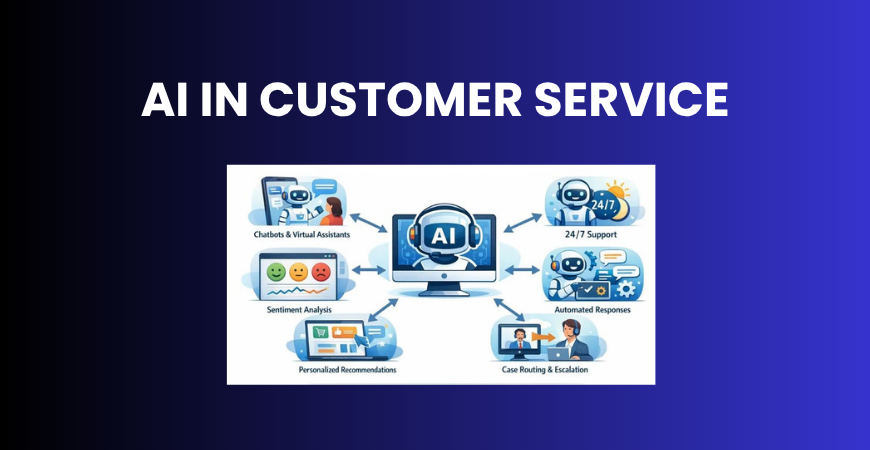
One of the most common applications is answering customer questions through chatbots and virtual assistants. These systems can provide information, guide customers through processes, and collect details before transferring complex cases to human agents.
For example, AI chatbots for business can help customers check order status, find products, understand services, or troubleshoot basic problems.
Automated Ticket Routing
AI can analyze incoming support requests and identify their subject or urgency. It can then route each ticket to the appropriate department or agent.
For example, a billing question can be sent to the accounts team while a technical issue goes directly to technical support. This can reduce unnecessary transfers and improve response efficiency.
Businesses can connect these workflows with marketing automation tools to coordinate customer communication and follow-ups across different channels.
AI-Generated Responses
Generative AI can help support agents create draft responses based on customer questions and available company information.
Instead of writing every response from scratch, an agent can review an AI-generated draft, make any necessary changes, and send the final answer. Human review remains important because inaccurate or inappropriate responses can damage customer trust.
Customer Sentiment Analysis
AI can analyze customer messages to identify signals of satisfaction, frustration, or dissatisfaction. This can help support teams recognize conversations that may require immediate attention.
For example, a customer repeatedly expressing frustration may be prioritized for human intervention rather than continuing with automated responses.
Conversation Summarization
Long support conversations can be difficult for agents to review quickly. AI can summarize previous interactions and highlight the main issue, actions already taken, and information the customer has provided.
This helps agents understand the situation faster, especially when a conversation is transferred between team members.
Self-Service Support
AI can help customers find answers without contacting a support agent. It can guide users through FAQs, troubleshooting instructions, account processes, and product information.
A strong self-service system can reduce unnecessary support requests while giving customers a faster way to solve simple problems.
Real-World Examples of AI in Customer Service
E-commerce
An online retailer can use AI to answer product questions, provide delivery updates, recommend products, and assist with return requests. More complicated issues can then be transferred to human agents.
Banking and Financial Services
Banks can use AI assistants to answer routine questions, guide customers through common processes, and provide account-related information. Sensitive or complex requests can be escalated to human representatives.
SaaS Businesses
Software companies can use AI to troubleshoot common problems, answer product questions, summarize support tickets, and identify when technical issues require human assistance.
| Industry | Common AI Use | Main Benefit |
| E-commerce | Order and product support | Faster responses |
| Banking | Virtual assistants | 24/7 assistance |
| SaaS | Troubleshooting | Faster issue resolution |
Best Practices for Using AI in Customer Service
Start With Routine Queries
Begin with repetitive, high-volume questions that have clear answers. This provides a practical starting point without making the system responsible for complex customer problems.
Use Accurate Information
AI should work with updated product details, policies, pricing, FAQs, and other trusted business information. Outdated information can lead to incorrect answers.
Keep Human Support Available
Customers should have an easy way to reach a human agent when an issue is complicated, sensitive, or outside the AI system’s capabilities.
Protect Customer Data
Businesses should carefully manage customer information and ensure that AI systems follow appropriate privacy and security practices.
Monitor Performance
Track metrics such as response time, resolution rate, customer satisfaction, escalation rate, and the number of issues resolved through automation.
How Businesses Can Implement AI in Customer Service
Businesses should first identify repetitive support tasks where AI can provide immediate value. They can then evaluate AI marketing tools and customer-service platforms based on their business needs, existing CRM systems, support channels, and budget.
Start with a limited use case, test the system, monitor customer feedback, and improve it before expanding AI across more support functions. Businesses should also train their teams so employees understand how to work alongside AI effectively.
Digiad Solution helps businesses identify suitable AI-driven approaches and build digital strategies that improve customer engagement, automation, and business efficiency.
Conclusion
AI in customer service helps businesses deliver faster, personalized support while reducing repetitive work. With accurate data, regular monitoring, and human oversight, businesses can use AI to improve customer experiences and service efficiency.
Frequently Asked Questions
What is AI in customer service?
AI in customer service involves using artificial intelligence to automate and support customer interactions, including answering questions, routing tickets, analyzing conversations, and assisting human agents.
What are the main benefits of AI in customer service?
The main benefits include faster responses, 24/7 support, improved agent productivity, personalization, lower operational workload, and better scalability.
How is AI used in customer service?
AI is used for chatbots, virtual assistants, ticket routing, response generation, sentiment analysis, conversation summaries, recommendations, and self-service support.
Can AI replace customer service agents?
AI can handle many routine tasks, but human agents remain important for complex issues, sensitive situations, relationship building, and decisions that require judgment.
Is AI customer service useful for small businesses?
Yes. Small businesses can start with simple applications such as FAQ chatbots, automated responses, or customer enquiry handling and expand their use of AI as their needs grow.