
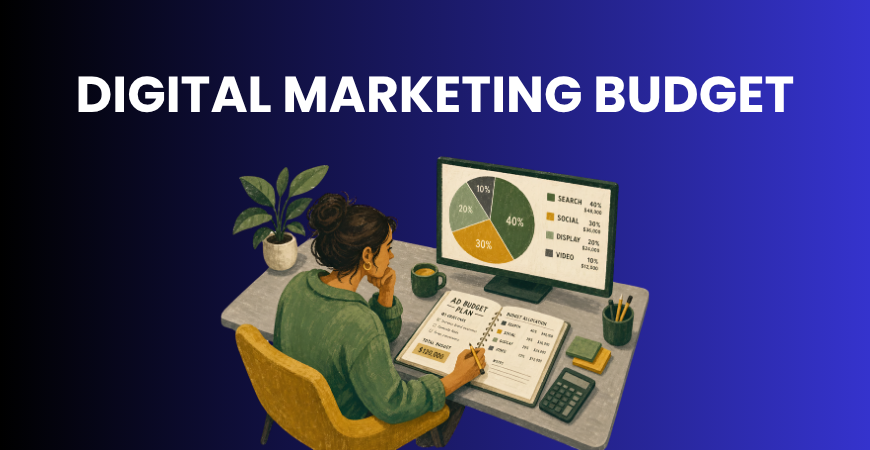
A digital marketing budget is not simply the amount a business sets aside for Google or Meta ads. It can include advertising, SEO, content, creative work, website improvements, marketing tools, analytics, and agency or freelancer costs. The right amount depends on what you are trying to achieve and what a new customer is worth to your business.
This matters even more in India, where digital advertising has become a major part of the overall advertising market. But growing digital ad spending does not mean every business should copy the same budget. Your spending needs to make sense for your customers, sales cycle, competition, and expected returns.
Digital Marketing Budget in India: What the Data Shows
The Indian digital advertising market has expanded significantly in recent years. According to the FICCI-EY Media & Entertainment report, digital advertising grew 26% in 2025 to ₹94,700 crore, accounting for around 63% of total advertising revenues covered by the report. The report also notes that more than ₹36,300 crore of digital advertising came from over one million small and medium enterprises and long-tail advertisers.
Another study provides a different figure because it uses a different measurement scope. The ET Brand Equity–Ipsos report puts India’s total advertising spend at ₹1.11 lakh crore in FY2025, with digital advertising at ₹49,000 crore, or 44% of total advertising spend. Digital grew 20% year over year in that measurement.
These numbers should not be treated as contradictory. They come from different reports and methodologies. The useful takeaway for a business owner is simpler: digital advertising is now a substantial part of India’s advertising economy, including for SMEs.
However, market growth alone does not tell you whether you should spend ₹20,000, ₹50,000 or ₹2 lakh a month. That decision needs to come from your own business economics.
How Much Should an Indian Business Spend on Digital Marketing?
There is no reliable universal rule that says every business should spend a fixed percentage of revenue on digital marketing.
A better starting point is to work backward from the number of customers you want to acquire.
A simple digital marketing budget formula
Monthly acquisition budget = Target new customers × Acceptable customer acquisition cost (CAC)
Suppose a local service business wants 20 additional customers each month and can reasonably afford to spend ₹1,500 to acquire one customer.
Its initial acquisition budget would be:
20 × ₹1,500 = ₹30,000 per month
Now work backward again.
If only 25% of qualified leads become customers, the business would need approximately 80 qualified leads to generate 20 customers.
If the business allocates ₹30,000 toward acquisition:
₹30,000 ÷ 80 = ₹375 target cost per qualified lead
This does not mean the business will automatically get leads at ₹375. It gives the business a financial target against which actual performance can be evaluated.
The calculation should also account for:
- Average order value
- Gross margin
- Repeat purchases
- Customer lifetime value
- Sales-team capacity
- Lead-to-customer conversion rate
- Geographic targeting
- Competition
- Seasonality
For a business where customers make repeat purchases, the acceptable CAC may be higher than for a business that gets only one transaction from each customer.
Your digital marketing strategy should therefore be connected to your sales economics rather than built around a number copied from another company.
What Does a Digital Marketing Budget Actually Include?
One of the most common budgeting mistakes is assuming that the advertising budget is the entire marketing budget.
For example, a business may spend ₹50,000 on Google Ads but also pay for content, creative production, website maintenance, analytics tools, and campaign management.
A practical budget can include:
| Cost area | What it may cover |
| Advertising | Google Ads, Meta Ads, YouTube and other paid channels |
| Agency or freelancer | Strategy, campaign management and execution |
| SEO and content | Keyword research, articles, technical SEO and organic growth |
| Creative | Graphics, videos, ad copy and social assets |
| Website | Landing pages, conversion improvements and technical work |
| Marketing tools | CRM, email, SEO, analytics and automation software |
| Testing | New audiences, channels, offers and creative variations |
| Measurement | Tracking, reporting and attribution |
This is where understanding digital marketing services becomes important when evaluating an agency. A quotation that appears cheaper may simply exclude important activities that another agency has included.
Before comparing agencies, ask:
- Is ad spend included or separate?
- Is creative production included?
- How frequently will campaigns be optimised?
- Who manages landing pages?
- What reporting will I receive?
- Are tracking and conversion setup included?
- What happens when additional tools are required?
A transparent budget is easier to evaluate than a low headline price with several additional costs appearing later.
How Much Does Google Ads Cost in India?
Google Ads does not have one fixed price per click. The amount you pay can change according to the keyword, competition, location, search intent, quality of the ad and landing page, among other factors.
Published India-focused agency benchmarks show substantial variation. For example, one 2025 dataset reports indicative CPC ranges of roughly ₹8–₹40 for D2C/e-commerce, ₹30–₹120 for education, ₹80–₹350 for real estate and ₹200–₹800 for legal services. These figures are third-party benchmarks, not prices guaranteed by Google.
More recent India-focused benchmark sources also show wide differences between industries, reinforcing the point that CPC should be used as a planning reference rather than a promised cost.
The more important question is not:
“How cheap can I get a click?”
It is:
“How much does it cost to acquire a customer who is actually valuable to my business?”
For example, assume:
- CPC = ₹50
- 20 clicks produce one lead
- 5 leads produce one customer
The advertising cost for that customer would be:
₹50 × 20 × 5 = ₹5,000
A ₹50 click may therefore produce a ₹5,000 customer acquisition cost.
Now imagine another campaign with a ₹100 CPC that produces a customer after fewer clicks and leads. The second campaign could be economically stronger despite having the higher CPC.
This is why businesses should track pay-per-click alongside conversion rate, CPL, and CAC rather than treating CPC as the final measure of success.
How to Allocate a Digital Marketing Budget
Instead of using a rigid percentage split, think of the budget as several connected areas.
1. Acquisition
This includes paid channels designed to generate immediate traffic, enquiries or purchases.
2. Organic growth
SEO and content can help build visibility that is not dependent entirely on paying for every visit.
3. Creative
Ads need relevant copy, images and videos. If creative quality is poor, increasing media spend may simply amplify weak campaigns.
4. Conversion infrastructure
A business needs landing pages, forms, calls, WhatsApp options or checkout experiences that make it easy for visitors to take the desired action.
5. Tools and measurement
CRM, analytics, tracking and reporting help determine which activities are actually producing business results.
6. Testing
Reserve some budget for testing new keywords, audiences, offers, creatives or channels. A budget with no room for experimentation can become too dependent on assumptions.
Your digital marketing funnel should guide how these areas work together. Spending heavily on traffic while neglecting landing pages or lead follow-up can create a large volume of activity without equivalent business growth.
Example Digital Marketing Budgets for Indian Businesses
The following examples are illustrative planning models, not recommended industry benchmarks. Actual budgets should be adjusted according to business economics and campaign performance.
Example 1: Local Service Business — ₹50,000/month
| Area | Illustrative allocation |
| Google/paid search | ₹25,000 |
| Meta or social advertising | ₹8,000 |
| SEO/content | ₹7,000 |
| Creative | ₹5,000 |
| Tracking/testing | ₹5,000 |
| Total | ₹50,000 |
This type of business may prioritise search because customers often have immediate local intent. However, the exact mix depends on the service and customer journey.
Example 2: D2C Business — ₹1 Lakh/month
| Area | Illustrative allocation |
| Paid acquisition | ₹55,000 |
| Retargeting | ₹10,000 |
| Creative production | ₹15,000 |
| SEO/content | ₹10,000 |
| Testing and analytics | ₹10,000 |
| Total | ₹1,00,000 |
For e-commerce, creative testing can be particularly important because several products, audiences and offers may need to be tested before a scalable combination emerges.
Example 3: B2B Business — ₹1 Lakh/month
| Area | Illustrative allocation |
| Search campaigns | ₹35,000 |
| SEO/content | ₹20,000 |
| Landing pages/conversion work | ₹15,000 |
| Creative and content assets | ₹10,000 |
| Lead nurturing/tools | ₹10,000 |
| Testing and analytics | ₹10,000 |
| Total | ₹1,00,000 |
B2B businesses often have longer sales cycles, so judging performance only by monthly lead volume can be misleading. A lead may take weeks or months to become revenue.
How to Calculate Whether Your Digital Marketing Budget Is Working
A budget should be reviewed through a chain of measurable outcomes:
Spend → Traffic → Leads → Qualified Leads → Customers → Revenue
Consider these metrics:
Cost per lead (CPL)
How much you spend to generate one lead.
Qualified lead rate
The percentage of leads that actually match your target customer profile.
Lead-to-customer conversion rate
How many leads eventually become paying customers.
Customer acquisition cost (CAC)
The total acquisition cost associated with obtaining a customer.
Return on ad spend (ROAS)
Revenue generated in relation to advertising spend. This is particularly useful for paid campaigns but does not represent the entire cost of marketing.
Marketing ROI
A broader calculation that considers the return generated relative to marketing investment.
This is where digital marketing KPIs become useful. Instead of reporting only impressions, clicks or followers, businesses can connect campaign activity to meaningful commercial outcomes.
A campaign generating 500 leads may look impressive, but if only two become customers, the number of leads alone does not tell the full story.
Likewise, a campaign producing 50 leads may be more valuable if 15 become customers.
Digital Marketing Budget Mistakes Indian Businesses Should Avoid
1. Setting a budget without a customer target
Start with how many customers or qualified enquiries you need, not an arbitrary spending figure.
2. Treating ad spend as the entire marketing budget
Management, creative, SEO, tools, and conversion improvements can also require investment.
3. Choosing channels because competitors use them
A channel that works for a national e-commerce company may not be suitable for a local professional service.
4. Scaling before tracking properly
If conversions are not being recorded correctly, increasing spend can make the problem more expensive.
5. Ignoring organic growth
Paid advertising can generate immediate visibility, but SEO and useful content can contribute to longer-term acquisition.
6. Judging campaigns only by clicks
Traffic is an input. Leads, customers, and revenue are closer to the actual business outcome.
7. Changing strategy too frequently
Some campaigns need sufficient data and time before meaningful conclusions can be drawn. Constantly changing targeting, creatives and budgets can make performance difficult to interpret.
When Should You Increase or Reduce Your Digital Marketing Budget?
Consider increasing your budget when tracking is reliable, lead quality and sales conversion are strong, your business can handle additional demand, and customer acquisition costs remain sustainable. A channel that consistently produces qualified customers is also a stronger candidate for additional investment.
Reconsider your budget when lead quality is poor, CAC is too high, landing pages convert poorly, sales follow-up is weak, or tracking cannot connect marketing activity with revenue. Budget decisions should come from performance data—not simply from what competitors appear to be spending.
How Digiad Solution Can Help Businesses Plan and Manage Their Budget
Choosing a digital marketing agency should start with the problem you need to solve. Poor search visibility may require SEO and content, while low enquiries may call for paid search, social campaigns or landing-page improvements. If traffic is already strong but sales are weak, conversion optimisation and lead follow-up may matter more than increasing ad spend. Digiad Solution can help businesses assess these needs and align their digital marketing efforts with specific growth goals.
When evaluating an agency, look beyond its fee. Ask how it will connect marketing activities to your business goals, what it will measure, which channels it recommends and why, and how performance will influence future spending. A good agency relationship should make your marketing investment clearer—not simply more expensive.

Frequently Asked Questions
How much should a small business spend on digital marketing in India?
There is no universal amount. Consider your target customers, acceptable CAC, customer value and conversion rates before deciding how much you can sustainably invest in acquisition.
What is a good monthly digital marketing budget?
A good budget is one that supports your business objective without becoming financially unsustainable. ₹30,000 may work for a focused local campaign but may be inadequate for national customer acquisition across multiple channels.
How much does Google Ads cost in India?
Costs vary by industry, keyword, location and competition. Third-party Indian benchmarks range from single-digit CPCs in some categories to several hundred rupees in competitive sectors. Treat these as directional figures, not guaranteed prices.
Is digital marketing expensive for small businesses?
It can be if a limited budget is spread across too many channels. A focused, well-tracked campaign is often easier to manage than trying to maintain every major platform.
Should I spend more on SEO or paid advertising?
It depends on your goals. Paid advertising can capture demand quickly, while SEO can build organic visibility over time. The right balance depends on your customer journey, competition and resources.
Does a higher marketing budget guarantee better results?
No. More spending can increase reach, but it cannot compensate for poor targeting, weak creative, low-converting pages or ineffective sales follow-up. Additional budget works best when the underlying campaign and measurement system are sound.
Conclusion
A digital marketing budget should be based on business goals, customer economics and measurable results—not a number copied from another company. Set your acquisition targets, determine an acceptable CAC, allocate spending where it can support those goals, and regularly measure what turns marketing spend into qualified leads, customers and revenue. The most useful budget is one your business can justify, measure and improve.


