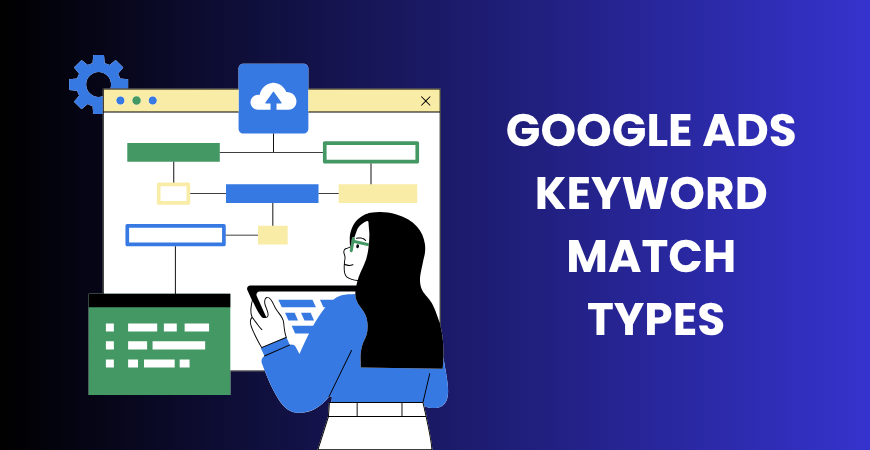
Choosing the right keywords is only part of building a successful Google Ads campaign. You also need to decide how closely a user’s search should relate to those keywords. Google Ads keyword match types help balance reach, relevance, and control.
Google offers three main match types: Broad Match, Phrase Match, and Exact Match. The right choice depends on your campaign goal, conversion data, budget, and desired level of control.
What Are Google Ads Keyword Match Types?
Keyword match types determine how closely a user’s search needs to relate to a keyword before your ad can be considered for that search.
Google Ads provides three main options:
- Broad Match – offers the widest reach.
- Phrase Match – balances reach and control.
- Exact Match – provides greater control over search intent.
Match types do not simply check whether the exact words appear in a search. Google also considers meaning and intent, so a search can trigger an ad even when it uses different wording.
For example, a keyword such as digital marketing course may match searches with similar intent, depending on the match type and other campaign signals.
Broad vs Phrase vs Exact Match: What’s the Difference?
The easiest way to understand the three options is to compare their relative reach and control.
| Match Type | Reach | Control | Best suited for |
| Broad Match | Higher | Lower | Discovery and wider reach |
| Phrase Match | Medium | Medium | Balanced targeting |
| Exact Match | Lower | Higher | Specific search intent |
Broad Match
Broad Match provides the widest reach. It can match searches related to the meaning of your keyword, even when they use different wording.
For example:
digital marketing course
may match searches related to digital marketing classes or training.
Broad Match can help discover new relevant searches and is particularly useful when combined with conversion-focused bidding. The trade-off is less direct control, so monitoring search-term performance is important.
Phrase Match
Phrase Match sits between Broad and Exact Match. You enter it using quotation marks:
“digital marketing course”
It can match searches that retain the meaning of the keyword while allowing additional words or variations.
For example:
- best digital marketing course
- digital marketing course for beginners
- digital marketing course near me
Phrase Match can work well when you want a balance between reach and relevance.
Exact Match
Exact Match provides the greatest level of control. You enter it using square brackets:
[digital marketing course]
Despite its name, Exact Match does not require a word-for-word search. Google can match searches with the same meaning or intent, including certain close variants.
It is therefore better understood as tighter control rather than literal matching.
Which Google Ads Keyword Match Type Should You Use?
There is no single match type that works best for every campaign.
Use Broad Match for More Reach
Broad Match may suit campaigns focused on discovering additional relevant searches. Consider it when:
- You want wider reach.
- You have reliable conversion data.
- You use conversion-focused bidding.
- You can regularly monitor search-term performance.
Use Phrase Match for a Balance
Phrase Match can be useful when you want more flexibility than Exact Match while maintaining a stronger connection to your keyword theme.
It may suit campaigns where:
- Search relevance is important.
- You want to capture keyword variations.
- The campaign has clearly defined search themes.
Use Exact Match for Tighter Control
Exact Match can make sense when specific search intent is particularly valuable.
Consider it when:
- You have proven high-value keywords.
- You want greater control over important searches.
- Your budget is limited.
- You understand which searches generate meaningful results.
Exact Match is not automatically better; it simply provides more control.
Can You Use Multiple Match Types in the Same Campaign?
Yes. You can use different match types for different purposes rather than applying one approach across every keyword.
| Campaign Need | Possible Match Type |
| Discover new relevant searches | Broad |
| Maintain balanced reach | Phrase |
| Focus on specific intent | Exact |
For example, Broad Match can support discovery, Phrase Match can target established themes, and Exact Match can focus on particularly valuable search intent.
Avoid unnecessary keyword duplication, however. Adding the same keyword in all three match types does not automatically improve performance and can make account management more complicated.
How to Choose the Right Match Type for Your Campaign
Consider these five factors before choosing a match type.
1. Define Your Campaign Goal
A campaign focused on discovering new customers may need more reach, while one targeting a small number of high-value searches may require greater control.
2. Consider Your Conversion Data
Broad Match can work well when Google has meaningful conversion signals to use for optimization. With limited or unreliable data, greater caution may be appropriate.
3. Look at Search Intent
Consider how specific the customer’s search needs to be. Strong commercial intent may justify tighter targeting, while broader discovery goals may benefit from more flexibility.
4. Consider Your Budget
A larger testing budget may allow more room for broader targeting. With a tighter budget, controlling irrelevant traffic can become more important.
5. Check Your Ads and Landing Pages
Your keywords, ads, and landing pages should provide a consistent experience. This is where broader Google Ads optimization matters because keyword targeting is only one part of campaign performance.
How to Optimize Keyword Match Types
Choosing a match type is not a one-time decision. Search behavior changes, new queries appear, and campaign performance can shift.
Review the Search Terms Report
Use the Search Terms report to identify:
- New relevant search ideas
- Irrelevant searches
- High-converting queries
- Expensive searches with poor results
- Search themes that deserve closer targeting
These insights can help you adjust your match-type strategy.
Add Negative Keywords
When irrelevant searches repeatedly trigger your ads, negative keywords can help prevent them from appearing for those searches.
For example, a paid course provider that does not offer free training may exclude searches containing “free” if they consistently prove irrelevant.
Using negative keywords in Google Ads alongside your keyword strategy can help improve traffic quality.
Review Bidding Alongside Match Types
Match types and bidding should be considered together. Broad Match, in particular, can work closely with Smart Bidding and conversion signals.
Your Google Ads bidding strategies should support the campaign objective rather than simply focusing on the lowest possible cost per click.
Measure Business Results
Do not judge a match type only by clicks or impressions. Review:
- Conversions
- Conversion rate
- Cost per conversion
- Conversion value
- ROAS where relevant
- Lead quality
A keyword generating fewer clicks may still be more valuable if it produces better-qualified conversions.
Common Google Ads Match Type Mistakes
Even a well-structured campaign can run into problems when match types are used without considering the bigger picture.
Using Exact Match for everything: This can restrict reach and limit opportunities to discover relevant searches.
Using Broad Match without monitoring: Broader targeting requires regular review of search-term performance.
Ignoring negative keywords: Irrelevant searches can still occur, particularly with broader targeting.
Judging performance by CTR alone: A high click-through rate does not necessarily mean the traffic is valuable.
Creating unnecessary duplicates: Using multiple match types without a clear purpose can make account management more complicated.
Assuming more control always means better performance: Tighter targeting can reduce irrelevant traffic but may also limit relevant opportunities.
If these issues continue across a campaign, a structured Google Ads audit can help identify problems with keywords, targeting, bidding, ads, tracking, and account structure.
Frequently Asked Questions
Which Google Ads keyword match type is best?
There is no universal best option. Broad Match supports wider reach, Phrase Match provides a balance, and Exact Match offers greater control.
Should I use Broad, Phrase, or Exact Match?
Choose based on your campaign objective, budget, conversion data, and desired level of control.
Is Exact Match better than Phrase Match?
Not necessarily. Exact Match provides more control, while Phrase Match allows greater reach. The appropriate choice depends on campaign needs.
Can I use all three match types together?
Yes. Different match types can serve different purposes within the same campaign or account.
Do Google Ads keyword match types still matter?
Yes. Although Google uses meaning and intent when matching searches, Broad, Phrase, and Exact Match still provide different levels of reach and control.
How often should I review match types?
Review search-term and conversion performance regularly enough to identify irrelevant traffic, new opportunities, and changes in campaign performance.
Conclusion
Choosing the right Google Ads keyword match types depends on your campaign goals, budget, conversion data, and desired level of control. Broad Match can expand reach, Phrase Match can provide balance, and Exact Match can offer tighter control. Reviewing search terms, bidding, conversions, and business results together will help you adjust your strategy as campaign data develops. Ongoing Google Ads management can also support these adjustments over time.