Quick Answer
SEO should remain the priority for most businesses, with GEO as a complementary strategy. SEO drives organic visibility, website traffic, and potential leads, while GEO helps businesses improve their chances of appearing in AI-generated answers. The best approach is to strengthen SEO fundamentals while gradually optimizing for AI-powered search.
Introduction
People no longer discover businesses only through traditional Google search results. They also ask AI-powered platforms for recommendations, comparisons, and answers. This shift has brought SEO vs GEO into focus, leaving many business owners wondering whether traditional search optimization is still enough to attract customers.
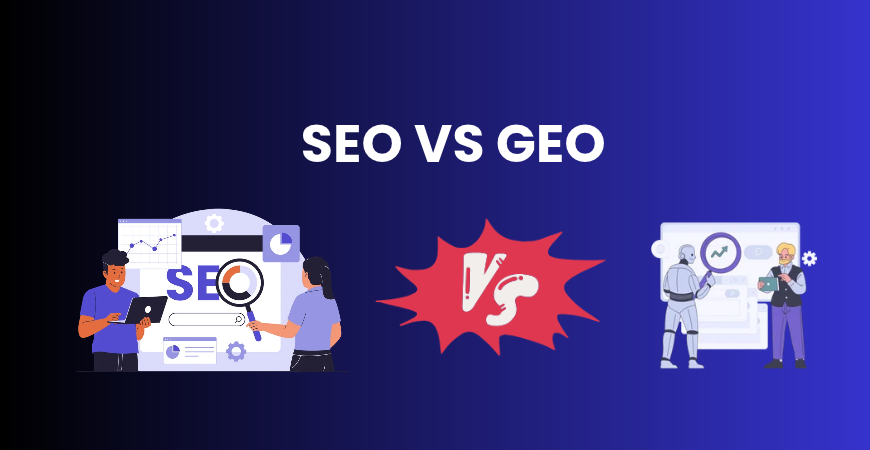
Search Engine Optimization (SEO) helps websites appear in organic search results, while Generative Engine Optimization (GEO) aims to improve visibility in AI-generated answers. Both can influence how potential customers discover your business, but they serve different purposes. Understanding these differences can help you decide where to focus your marketing efforts.
What Is SEO and How Does It Help Businesses?
Search Engine Optimization (SEO) involves improving a website’s content, technical performance, and relevance so search engines can discover, understand, and rank its pages.
A well-planned SEO strategy helps businesses reach customers searching for specific solutions. For example, someone searching for “digital marketing agency in Kolkata” may be ready to compare service providers or request a consultation.
SEO supports businesses through:
- Organic visibility: Helping relevant pages appear in search results.
- Website traffic: Attracting visitors searching for related products or services.
- Lead generation: Connecting businesses with potential customers.
- Local discovery: Improving visibility for location-based searches.
- Long-term growth: Building useful content and website improvements that can continue delivering value.
SEO performance depends on competition, website quality, search intent, and several other factors. Rankings and traffic are never guaranteed.
What Is GEO and How Does It Work?
Generative Engine Optimization (GEO) refers to practices intended to improve how content and brands are represented in AI-generated search responses.
Platforms such as ChatGPT search, Google AI Overviews, and Perplexity can provide synthesized answers and, depending on the experience, reference external sources. GEO aims to make business information accessible, understandable, and credible enough to be considered when these systems generate responses.
For example, someone might ask an AI assistant, “What should I look for when hiring a digital marketing agency?” A useful article explaining agency services, pricing considerations, and selection criteria could potentially be referenced in the response.
As AI in marketing continues to develop, businesses need to consider how customers research solutions through conversational search.
However, GEO cannot guarantee that an AI platform will mention, recommend, or cite a particular business. Different systems select and present information differently.
SEO vs GEO: Key Differences Businesses Should Know
Although both approaches aim to improve discoverability, they differ in where visibility appears and how success is measured.
| Factor | SEO | GEO |
| Primary goal | Improve organic search visibility | Improve visibility in AI-generated answers |
| Main platforms | Google, Bing, and other search engines | ChatGPT search, AI Overviews, Perplexity, and similar experiences |
| Content approach | Search intent, relevance, website quality | Clear explanations, credible information, accessible sources |
| Typical outcome | Search impressions, rankings, website visits | Brand mentions, citations, and possible referral visits |
| Measurement | Search Console, analytics, rankings, conversions | AI visibility checks, referral traffic, mentions, citations |
| Main challenge | Search competition and algorithm changes | Limited control and evolving measurement methods |
An important distinction is that GEO is not entirely separate from SEO. Accessible websites, reliable information, and helpful content can support visibility across both traditional and AI-powered search experiences.
SEO vs GEO: Which Is Better for Different Business Goals?
The right priority depends on what your business wants to achieve.
1. Getting More Website Traffic
SEO generally offers a more established way to attract measurable website visits. When a page ranks for relevant searches, users can click through to explore its products, services, or information.
GEO may also generate referral visits when AI platforms include clickable citations or links. However, users can sometimes get their answers without visiting the source website.
Better starting point: SEO, particularly when organic traffic is a primary business objective.
2. Generating Leads and Enquiries
SEO can help businesses reach customers with clear purchasing intent. Searches such as “SEO services near me” or “website development company” may indicate that someone is actively looking for a provider.
GEO can support earlier research stages, when people ask AI assistants to explain services, compare approaches, or suggest what to consider before hiring.
Better approach: Prioritize SEO for direct search demand and use GEO to support research-stage visibility.
3. Building Brand Awareness and Credibility
Traditional SEO helps customers discover a business through informative articles, service pages, and relevant search results.
GEO introduces another potential discovery opportunity: appearing as a source or being mentioned in an AI-generated explanation.
For both approaches, accurate business information, genuine expertise, useful examples, and trustworthy references matter. Neither rankings nor AI mentions automatically establish credibility.
Better approach: Combine SEO and GEO to support visibility across different discovery experiences.
4. Improving Local Business Visibility
For restaurants, clinics, law firms, and other location-based businesses, local search remains especially important.
Effective local SEO strategies involve maintaining accurate Google Business Profile information, creating useful location-specific pages, and ensuring consistent business details across relevant platforms.
Clear location and service information may also help AI systems understand a business, although appearing in AI-generated local recommendations is not guaranteed.
Better starting point: Local SEO, supported by accurate, accessible information that AI platforms may also use.
5. Preparing for Changes in Search Behaviour
Customers increasingly have different ways to research businesses. Some prefer conventional search results, while others ask detailed questions through AI assistants.
Businesses that monitor both environments can better understand changing discovery patterns.
Better approach: Maintain SEO performance while testing GEO improvements, rather than shifting resources away from channels already generating enquiries.
Should Small Businesses Invest in SEO or GEO First?
For most small businesses with limited marketing budgets, SEO is the more practical starting point.
A local interior design company, for example, may benefit more immediately from improving its service pages, location visibility, and organic rankings than from investing heavily in AI-specific visibility monitoring.
A B2B software company, however, might find GEO particularly relevant because potential buyers often research complex solutions, compare providers, and ask detailed questions before contacting a sales team.
The decision should consider three factors:
- Customer behaviour: Where do potential customers research and compare solutions?
- Current performance: Is the website already attracting relevant organic visitors and enquiries?
- Available resources: Can the business maintain its existing search visibility while exploring AI discovery?
For businesses evaluating their next steps, Digiad Solution offers digital marketing services, including SEO and content marketing, that can help address existing search visibility challenges. Understanding where customers discover your business is an important starting point before deciding how much attention to give emerging AI search opportunities.
The goal is not to follow every emerging trend. It is to develop a search visibility plan that supports measurable business objectives.

How to Build an SEO and GEO Strategy Together
Businesses do not need completely separate content strategies for traditional search and AI-powered discovery. Many foundational improvements can support both.
Step 1: Strengthen Your Website’s SEO Foundation
Start with technical accessibility, mobile usability, logical website structure, and helpful service pages.
Following best SEO practices makes it easier for search engines to discover and understand your content. These fundamentals can also support AI search experiences that rely on accessible web information.
Check that important pages are crawlable, internal links work properly, and business details are accurate.
Step 2: Create Content That Answers Real Customer Questions
Useful content should address questions customers genuinely ask.
For example, instead of publishing a generic article about digital marketing, a business could explain how to choose between SEO and paid advertising based on budget, goals, and expected timelines.
Effective SEO content optimization involves matching search intent, organizing information clearly, and improving existing pages with accurate explanations and relevant examples.
These qualities also make content more useful to readers arriving through AI-powered search.
Step 3: Make Business Information Clear and Consistent
Clearly explain what your business offers, where it operates, and how customers can contact you.
Include relevant details such as services, locations, team expertise, and verifiable credentials where appropriate. Structured data can help eligible search systems interpret certain information, but it does not guarantee rankings or AI citations.
Avoid exaggerated claims that cannot be supported.
Step 4: Build Credibility Beyond Your Website
Search visibility is not determined by website content alone.
Relevant industry mentions, genuine customer reviews, reputable references, and accurate business listings can help people evaluate your credibility.
Businesses should focus on earning legitimate recognition rather than creating artificial mentions or publishing unsupported claims to influence AI responses.
Step 5: Track Traditional Search and AI Visibility
Measure whether your efforts contribute to meaningful business outcomes.
Traditional SEO reporting can track organic clicks, impressions, enquiries, and conversions using tools such as Google Search Console and website analytics.
For GEO, businesses can monitor observable AI citations, brand mentions, and referral visits where available. Because AI-generated responses can vary, occasional manual checks should not be treated as definitive performance measurements.
Compare these findings with actual enquiries and customer behaviour before adjusting your strategy.
Frequently Asked Questions
Is GEO replacing SEO?
No. In the SEO vs GEO comparison, both serve different purposes. SEO improves traditional search visibility, while GEO focuses on AI-generated answers.
Can a business do GEO without SEO?
Yes, but strong SEO fundamentals improve content accessibility and support visibility across both search experiences.
Does GEO help a website rank higher on Google?
Not directly. Understanding SEO vs GEO helps businesses recognize that clearer content and better website structure can support both approaches without guaranteeing higher rankings.
How can businesses measure GEO performance?
Track AI mentions, citations, referral traffic, and enquiries where measurable. GEO measurement is still evolving.
Is GEO worth investing in for small businesses?
Yes, particularly when customers use AI search to research services. When deciding between SEO vs GEO, small businesses should prioritize SEO fundamentals before expanding into AI search optimization.
Conclusion
In the SEO vs GEO debate, SEO remains the foundation for driving organic traffic and potential leads, while GEO creates opportunities for visibility in AI-generated answers. Businesses should prioritize SEO, gradually adopt GEO practices, and focus on whichever approach delivers meaningful results.