Introduction
AI marketing agents are changing how businesses handle repetitive marketing tasks, customer interactions, data analysis, and campaign management. Unlike basic automation that follows fixed instructions, AI agents can analyze information, make decisions within defined parameters, and perform multiple steps toward a marketing goal.
For businesses, this can mean less manual work, more personalized customer experiences, faster responses, and more efficient operations. However, their value depends on suitable tools, reliable data, clear objectives, and appropriate human oversight.
What Are AI Marketing Agents?
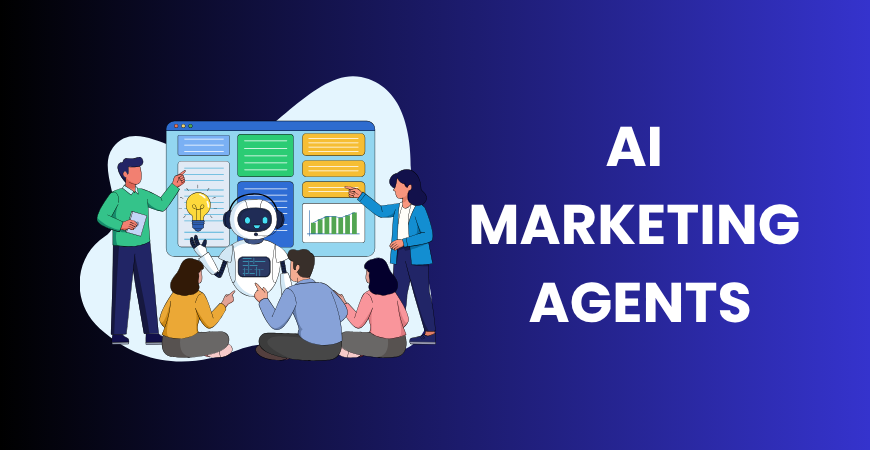
AI marketing agents are AI-powered systems designed to perform or coordinate marketing tasks based on a specific objective. They can interpret information, determine appropriate actions, use connected tools, and evaluate outcomes within the permissions given to them.
The basic process is:
Goal → Analyze → Decide → Act → Evaluate
For example, instead of simply sending an email after a form submission, an AI agent may analyze available customer information, determine the appropriate workflow, initiate an action, and use the resulting interaction to guide the next step.
Common applications include:
- Lead qualification and nurturing
- Customer segmentation
- Campaign monitoring
- Content workflows
- Customer engagement
- Marketing analysis
- Re-engagement
They can also work alongside AI marketing automation, where automated workflows handle routine processes and AI supports more adaptive decisions.
Benefits of AI Marketing Agents for Modern Businesses
1. Automate Complex Marketing Tasks
AI agents can handle multi-step tasks instead of performing only one action after a fixed trigger.
Depending on their configuration, they can monitor campaigns, update segments, follow up with leads, organize data, or initiate re-engagement workflows.
This can reduce manual coordination between different marketing activities, although businesses should define clear limits and approval points for important decisions.
2. Save Time and Reduce Repetitive Work
Marketing teams spend considerable time organizing leads, checking campaign data, preparing reports, and managing follow-ups.
AI agents can handle some of these repetitive activities automatically. For example, an agent could monitor lead engagement and flag inactive prospects for a suitable re-engagement workflow.
This gives marketers more time for strategy, creativity, relationship building, and decision-making.
3. Improve Marketing Personalization
Customer interests, behavior, and buying stages can vary considerably. AI agents can analyze available information to help businesses deliver more relevant communication.
An e-commerce business, for instance, could use customer activity to determine which product recommendations may be appropriate.
AI personalization can complement this approach by making customer interactions more relevant. However, personalization should remain useful rather than intrusive.
4. Support Faster Lead Management
Lead management involves several stages, including qualification, follow-up, nurturing, and sales handover.
AI agents can analyze lead information and engagement signals to help prioritize prospects and initiate appropriate workflows.
For example, a highly engaged prospect might enter a more sales-focused sequence, while a new lead could receive educational content first.
AI lead generation can therefore become part of a wider approach that connects lead acquisition with qualification and nurturing.
Human involvement remains important when a prospect requires a complex sales conversation.
5. Enable Data-Driven Marketing Decisions
Marketing data comes from websites, email campaigns, advertising platforms, CRM systems, and customer interactions. AI agents can help monitor this information, identify patterns, and highlight areas that need attention.
For example, an agent could detect a significant change in campaign engagement and alert the marketing team.
Predictive analytics can complement this process by using historical and behavioral data to estimate potential future outcomes. Such predictions should still be evaluated in context because they depend on data quality and assumptions.
6. Improve Customer Engagement
AI agents can support customer engagement through timely responses, recommendations, follow-ups, and routine service interactions.
AI chatbots can handle common questions and provide immediate assistance as part of a wider customer-service workflow.
However, complex complaints and sensitive situations should have a clear path to human support. AI should improve accessibility and responsiveness without removing the human element where it is needed.
7. Help Businesses Scale Marketing Operations
As businesses grow, so do their audiences, campaigns, channels, and marketing workflows.
AI agents can help coordinate repetitive processes across larger volumes of activity. For example, a growing business may need to manage different lead journeys, customer segments, content workflows, and re-engagement campaigns simultaneously.
Automation can make these processes easier to manage, but effective scaling still requires accurate data, suitable technology, monitoring, and human oversight.
How Do AI Marketing Agents Work in Marketing?
AI agents can support different parts of the marketing process, depending on their capabilities and integrations.
Campaign Monitoring
Agents can monitor selected campaign metrics and alert marketers when changes require attention.
Lead Qualification
They can analyze available lead information and engagement signals to support prioritization and nurturing.
Content Workflows
AI agents can coordinate parts of content research, creation, distribution, or updating. AI content creation can support individual content tasks within these workflows.
Audience Segmentation
Agents can help organize audiences based on behavioral or engagement data and connect segments with relevant campaigns.
Marketing Automation
Agents can work alongside existing automation platforms to coordinate multi-step processes. Businesses should first evaluate whether their existing marketing automation tools already address the problem.
Performance Analysis
Agents can summarize marketing data, identify unusual changes, and surface areas that marketers may want to investigate.
The exact capabilities depend on the system, integrations, permissions, and available data.
What Should Businesses Consider Before Using AI Marketing Agents?
Businesses should adopt AI agents because they solve a specific marketing problem, not simply because the technology is available.
Consider these factors:
- Define the problem: Start with a repetitive, data-driven, or time-consuming task.
- Check existing technology: Determine whether current platforms already provide the required functionality.
- Evaluate integrations: Check whether the agent works with your CRM, analytics, advertising, or other systems.
- Consider data privacy: Understand how customer information is accessed, processed, and protected.
- Set human review points: Decide which actions can happen automatically and which require approval.
- Start small: Test one measurable use case before expanding to more complex workflows.
Businesses that need broader support can also consider a digital marketing agency when internal teams lack the time or expertise to connect AI with SEO, advertising, content, analytics, or automation. For example, Digiad Solution can be evaluated based on the specific services required, its approach, reporting process, transparency, and understanding of business objectives.
A broader AI marketing strategy can help ensure that AI agents support actual business goals instead of becoming isolated technology projects.

Conclusion
AI marketing agents can help businesses automate complex workflows, reduce repetitive work, personalize customer interactions, manage leads, analyze marketing data, improve engagement, and scale operations. Their effectiveness depends on clear objectives, reliable data, suitable integrations, responsible data practices, and human oversight. Starting with focused use cases and measuring their impact can help businesses identify where AI agents genuinely add value while keeping human expertise at the center of important marketing decisions.
Frequently Asked Questions
What are AI marketing agents?
AI marketing agents are AI-powered systems that can analyze information, make decisions within defined parameters, and perform or coordinate marketing tasks toward a specific objective.
What are the main benefits of AI agents?
They can help automate complex tasks, reduce repetitive work, improve personalization, support lead management, analyze data, improve customer engagement, and scale marketing operations.
How do AI marketing agents differ from marketing automation?
Traditional automation generally follows predefined rules and triggers. AI agents can use available data to analyze situations, make decisions within their permissions, and coordinate multiple steps toward a goal.
Can small businesses use AI marketing agents?
Yes. Small businesses can start with focused use cases such as lead management, customer engagement, reporting, or repetitive workflows, depending on their needs and resources.
Do AI marketing agents replace marketers?
No. They support marketing activities rather than eliminating the need for human expertise. Strategy, creativity, judgment, relationship management, and oversight remain important.