Introduction
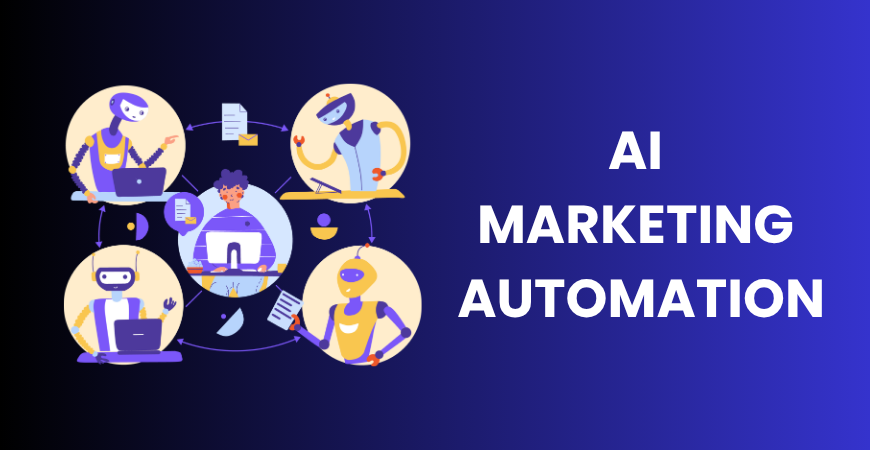
AI marketing automation combines artificial intelligence with automated marketing workflows to help businesses analyze customer behavior, personalize communication, nurture leads, and manage repetitive tasks more efficiently. Unlike basic automation, AI can use data and patterns to make marketing activities more responsive.
It can support email campaigns, lead nurturing, segmentation, advertising, customer service, and re-engagement. However, effective automation depends on reliable data, suitable tools, clear goals, and human oversight.
What Is AI Marketing Automation?
AI marketing automation uses artificial intelligence within automated marketing processes to analyze data, identify patterns, personalize interactions, and support campaign decisions.
Traditional automation generally follows fixed rules: “If X happens, do Y.” AI-powered automation can consider customer behavior and available data when deciding what action may be more relevant.
Common applications include:
- Customer segmentation
- Lead scoring and nurturing
- Personalized email campaigns
- Content recommendations
- Advertising optimization
- Customer re-engagement
- Automated customer support
Businesses can explore marketing automation tools to understand the wider range of platforms available for these activities.
How Does AI Marketing Automation Work?
The process can be simplified into five steps:
1. Collect Customer Data
Information can come from website activity, forms, CRM records, purchases, emails, and campaign interactions.
2. Analyze Behavior
AI identifies patterns in customer activity, such as repeated website visits, increased engagement, or changes in purchasing behavior.
3. Segment or Score Customers
Customers can be grouped according to their behavior, interests, engagement, or position in the buying journey. AI can also support lead scoring to identify prospects that may need more attention.
This makes AI lead generation relevant to businesses that want to move beyond collecting leads and focus on nurturing and prioritizing them.
4. Trigger Automated Actions
The system can automatically send emails, recommend content, display advertisements, assign leads, or begin re-engagement sequences.
5. Measure and Improve
Campaign results provide data that marketers can use to evaluate performance and improve future workflows.
The basic cycle is:
Data → Analysis → Action → Measurement → Improvement
Benefits of AI Marketing Automation
Saves Time
Automation reduces repetitive work such as sending follow-ups, organizing leads, updating segments, and managing routine campaigns.
Improves Personalization
AI can use customer behavior and available data to make communication more relevant. For example, an ecommerce business can recommend products based on browsing or purchasing activity.
This is where AI personalization can support more relevant customer experiences.
Supports Lead Nurturing
Not every lead is ready to buy immediately. Automated workflows can provide educational content and follow-ups based on a prospect’s interactions, helping move them through the buying journey.
Enables Data-Driven Decisions
AI can identify patterns across marketing data that may be difficult to spot manually. Predictive analytics can further support businesses in identifying potential opportunities and making informed decisions.
Improves Efficiency and Scalability
Automated workflows help businesses manage larger audiences and more complex customer journeys without manually handling every interaction.
However, scaling automation should not mean eliminating human involvement. Strategic decisions and complex customer situations still require human judgment.

How AI Is Used in Marketing Automation
Email Marketing
AI can help create more relevant email workflows based on customer engagement. Different sequences can be used for new subscribers, active prospects, customers, or inactive users.
Lead Nurturing
AI-powered workflows can help identify where prospects are in the buying journey and deliver suitable communication at different stages.
Customer Segmentation
Businesses can use behavioral and engagement data to create more useful segments instead of relying only on broad demographic categories.
Content Recommendations
AI can analyze previous interactions to recommend relevant articles, videos, products, or other content.
Businesses can also use AI content creation to support content workflows, but generated content should still be reviewed for accuracy, relevance, and brand consistency.
Advertising and Retargeting
AI can analyze audience behavior and campaign performance to support advertising decisions and retargeting strategies. Human oversight remains important because automated optimization depends on accurate tracking, suitable goals, and quality data.
Customer Service
Automated systems can answer common questions and direct users toward relevant information. AI chatbots can support this part of a broader automation strategy.
However, complex complaints and sensitive situations should have an option for human assistance.
Re-Engagement
Businesses can use automated campaigns to reconnect with inactive customers or prospects through relevant content, reminders, or updates.
Choosing an AI Marketing Automation Tool
The right tool depends on your business goals, existing technology, audience, workflow complexity, and budget. Instead of choosing a platform simply because it offers many AI features, focus on whether it solves a real marketing problem.
| Factor | What to consider |
| Automation | Can it support the workflows you need? |
| AI features | Do its AI capabilities provide useful marketing value? |
| Integrations | Can it connect with your existing platforms? |
| Segmentation | Can it create useful audience groups? |
| Reporting | Can you measure campaign and business outcomes? |
| Data controls | Does it provide suitable privacy and data-management features? |
| Usability | Can your team manage it effectively? |
| Scalability | Can it support future marketing needs? |
Understanding different AI marketing tools can help businesses compare platforms according to their actual requirements rather than popularity alone.
For businesses that need broader digital marketing support, an agency such as Digiad Solution may also be considered when internal teams lack the time or expertise to manage areas such as SEO, paid advertising, content, analytics, or automation. Before choosing an agency, consider the services relevant to your business, its approach, reporting process, transparency, and understanding of your objectives.
Best Practices for AI Marketing Automation
Start With a Clear Goal
Automate a process because it solves a marketing problem, not simply because automation is available.
Map the Customer Journey
Understand what customers typically do before, during, and after a purchase. This helps identify where automation can add genuine value.
Use Reliable Data
AI depends on the information available to it. Keep customer data organized and make sure tracking is accurate before relying heavily on automated decisions.
Keep Personalization Relevant
Personalization should make communication more useful rather than intrusive. Use customer information thoughtfully and avoid unnecessary personalization.
Maintain Human Oversight
Review important campaigns, content, recommendations, and customer communications. AI should support marketing teams rather than remove human judgment entirely.
Test and Measure
Test messages, timing, segments, and workflows, then measure results against meaningful business goals such as conversions, qualified leads, retention, engagement, or acquisition cost.
A broader AI marketing strategy can help connect automation with business objectives instead of treating it as an isolated tactic.
Conclusion
AI marketing automation can help businesses combine automated workflows with AI-driven analysis, personalization, segmentation, and optimization. Its value depends on solving genuine marketing problems rather than simply automating more tasks. With suitable tools, reliable data, human oversight, continuous testing, and meaningful measurement, businesses can use AI to make marketing operations more efficient and customer experiences more relevant.
Frequently Asked Questions
What is AI marketing automation?
It uses artificial intelligence within automated marketing workflows to analyze customer data, personalize communication, and automate relevant marketing actions.
What are the benefits?
Key benefits include saving time, improving personalization, supporting lead nurturing, enabling data-driven decisions, and making marketing activities easier to scale.
What are examples of AI marketing automation?
Common examples include automated email campaigns, lead nurturing, customer segmentation, content recommendations, advertising, customer-service automation, and re-engagement campaigns.
How do I choose an AI marketing automation tool?
Start by identifying your marketing goals and the problem you want to solve. Then compare automation features, AI capabilities, integrations, reporting, data controls, usability, and scalability.