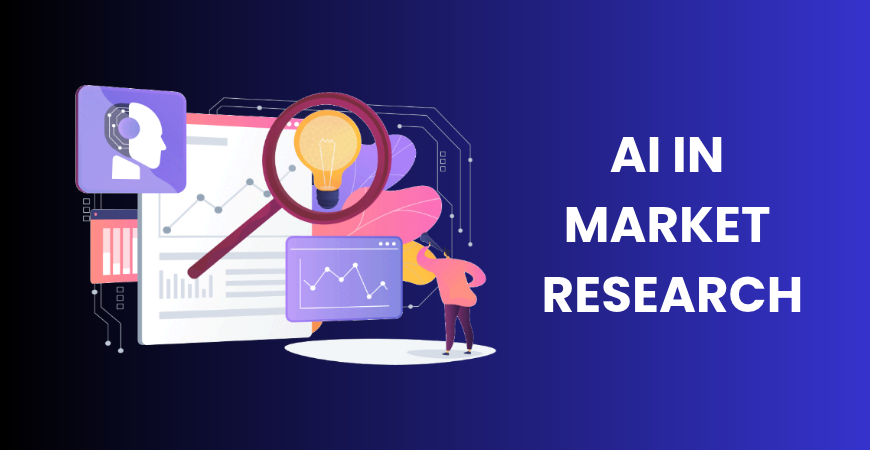
Understanding customers, competitors, and industry trends is essential for making informed business decisions. AI in market research is changing how businesses gather and analyse information by using artificial intelligence to identify patterns, understand customer preferences, and discover potential market opportunities.
Instead of organising large amounts of information manually, businesses can use AI-powered tools to analyse feedback, monitor trends, and uncover useful insights. This helps them understand their markets and make more informed decisions.
What Is AI in Market Research?
AI in market research refers to using artificial intelligence to collect, organise, analyse, and interpret market-related information. It helps businesses understand customers, evaluate competitors, monitor industry trends, and identify potential opportunities.
Traditional market research relies on methods such as surveys, interviews, questionnaires, and focus groups. These remain valuable, but analysing large amounts of information can be time-consuming.
AI introduces additional ways to process research data through technologies such as machine learning, natural language processing (NLP), and predictive analytics.
Businesses can use AI marketing tools to:
- Identify customer behaviour patterns.
- Analyse reviews and survey responses.
- Monitor changing market interests.
- Organise competitor information.
- Estimate potential customer demand.
- Discover opportunities for new products or services.
The right tools depend on the research objective, available data, and type of analysis required.
How Is AI Transforming Market Research?
AI is changing market research by making several activities easier to organise and analyse.
Automating Data Collection
Market research involves gathering information from surveys, customer reviews, website interactions, social media discussions, and industry reports.
AI-powered systems can collect and organise information from supported sources, reducing repetitive manual work.
For example, a business researching customer preferences for a new product can use automated workflows to organise survey responses and feedback into meaningful categories. AI marketing automation can support these repetitive research activities, although businesses must still verify the accuracy and relevance of the information.
Analysing Large Amounts of Data
AI can process large datasets to identify patterns, relationships, and recurring themes.
For example, an online retailer may discover that certain products are frequently purchased together or that customer demand changes during particular periods.
AI can also help marketers organise search terms and understand what people are looking for online, supporting keyword research and the discovery of relevant market interests.
Understanding Customer Behaviour
AI can analyse browsing activity, purchase history, product preferences, and customer feedback to identify behavioural patterns.
For example, a retailer may discover that customers frequently compare product features before purchasing. This insight could encourage the business to create clearer product comparisons and buying guides.
Such analysis helps businesses understand different audience needs instead of treating every customer alike.
Monitoring Market Trends
Customer interests and market demand change over time. AI can help businesses monitor online discussions, search trends, reviews, and industry publications to identify emerging interests.
For example, a fashion retailer may notice growing online interest in a particular clothing style and investigate whether it represents a wider change in customer demand.
However, an increase in online interest does not always indicate a lasting trend. Businesses should validate important findings using multiple sources.
Analysing Competitors
AI can help organise publicly available information from competitor websites, product descriptions, customer reviews, and published content.
For example, a company entering the skincare market may compare competing products, customer feedback, and publicly available pricing information to understand existing market offerings.
This supports competitor analysis by helping businesses identify potential gaps and areas that deserve further research. Important findings should still be verified because online information may be incomplete or outdated.
Predicting Market Trends and Demand
Predictive analytics uses historical information and analytical models to estimate possible future outcomes.
An online retailer, for instance, may examine previous festive-season purchases to estimate which product categories could experience increased demand during the next season.
These insights can support inventory planning, product decisions, and marketing preparation. However, predictions are estimates, not guaranteed outcomes.
How Do Businesses Use AI in Market Research?
AI research becomes more valuable when businesses apply the findings to practical decisions.
Identifying Target Audiences
AI can analyse demographic information, customer interests, purchasing patterns, and online interactions to identify different audience groups.
For example, an educational institution may distinguish students exploring career options from working professionals interested in developing new skills. This helps businesses create more relevant communication.
Understanding Customer Sentiment
Natural language processing can analyse customer reviews, survey responses, and social media comments to identify positive, negative, or neutral opinions.
For example, a restaurant chain may discover repeated complaints about delivery delays by analysing customer reviews.
These findings can help businesses understand customer concerns and identify areas for improvement.
Discovering Market Opportunities
AI can examine customer feedback, search behaviour, and industry discussions to identify unmet needs or potential market gaps.
For example, a software company may discover that customers frequently request a feature that is missing from several competing products.
This provides a direction for further research, but businesses should validate the opportunity through customer interviews, surveys, and market testing.
Evaluating Products and Services
AI can analyse product reviews, customer enquiries, and survey responses to understand how people perceive existing products or services.
For example, an electronics company may identify repeated complaints about battery life or product usability. These findings can help the business prioritise improvements.
Supporting Marketing Decisions
Research findings can guide product positioning, pricing considerations, advertising, and promotional planning.
For example, if customers value product reliability more than additional features, a business can use this insight when developing its messaging.
These findings can strengthen a digital marketing strategy by helping businesses align campaigns with actual audience interests rather than relying entirely on assumptions.
Examples of AI in Market Research Across Industries
Different industries can use AI research according to their customers and business objectives.
E-commerce
Online stores can analyse browsing activity, purchase history, and product reviews to understand shopping preferences. They can also identify growing interest in particular product categories and investigate changes in customer demand.
Retail
Retailers can examine sales records, customer feedback, and seasonal purchasing patterns to support product selection, promotional planning, and inventory decisions.
Banking and Financial Services
Financial institutions can analyse customer feedback and service interactions to understand changing expectations. Repeated complaints about digital banking services, for example, may indicate areas where the customer experience needs improvement.
Education
Educational institutions can research course interests, learner preferences, and demand for professional skills. These insights can help them understand which subjects prospective learners are exploring and develop more relevant content marketing topics.
Benefits of Using AI in Market Research
When implemented appropriately, AI can offer several advantages:
- Faster Data Analysis: Processes large amounts of information more efficiently.
- Better Customer Understanding: Identifies behavioural patterns and recurring concerns.
- Informed Decision-Making: Supports product, pricing, and marketing decisions.
- Trend Identification: Helps monitor changing customer interests and market activity.
- Efficient Research Workflows: Reduces repetitive manual tasks.
- Search Insights: Helps identify website improvement opportunities and areas that may require an SEO audit.
AI does not guarantee better business outcomes. Its value depends on the quality of the information and how businesses apply the findings.

Challenges and Limitations of AI in Market Research
Despite its advantages, AI has limitations that businesses should consider.
- Data Accuracy: Incomplete or outdated information can produce misleading findings.
- Data Privacy: Businesses must handle customer information responsibly and follow applicable data protection requirements.
- AI Bias: Biased datasets can influence analysis and produce unbalanced conclusions.
- Lack of Human Context: AI may identify patterns without fully understanding why customers behave in certain ways.
- Implementation Costs: Some solutions require investment in software, integration, and technical expertise.
- Outdated Information: Old or irrelevant data may not reflect current market conditions.
Businesses should start with a clear research objective, use reliable information, and verify important findings through human analysis and traditional research methods. Market research should inform a digital marketing strategy, not replace sound business judgement.
Conclusion
AI is transforming market research by helping businesses collect information, understand customer behaviour, monitor market trends, and identify potential opportunities more efficiently. From analysing customer feedback to evaluating competitors and estimating demand, AI can support better-informed decisions. However, it should complement traditional research methods and human judgement rather than replace them. Businesses that combine reliable data, suitable AI technologies, and careful analysis can develop a clearer understanding of their markets and make more informed decisions.
Frequently Asked Questions
1. What is AI in market research?
It refers to using artificial intelligence to collect, analyse, and interpret market information. It helps businesses understand customers, monitor competitors, and identify trends.
2. How is AI changing market research?
AI makes research more efficient through automated data collection, large-scale analysis, sentiment analysis, trend monitoring, and predictive analytics.
3. What AI technologies are used in market research?
Common technologies include machine learning, natural language processing, predictive analytics, and text analysis.
4. Can AI replace traditional market research?
No. AI supports research activities, but surveys, interviews, and focus groups remain valuable for understanding customer motivations and collecting direct feedback.
5. How do businesses use AI to understand customer behaviour?
Businesses analyse purchase history, browsing activity, customer feedback, and engagement patterns to identify preferences and understand different audience groups.
6. What are the limitations of AI in market research?
Key limitations include inaccurate data, algorithmic bias, privacy concerns, implementation costs, and difficulty understanding human context. Human review remains essential for reliable research.